
Free BaZi Chart
Four Pillars online, with personality highlights
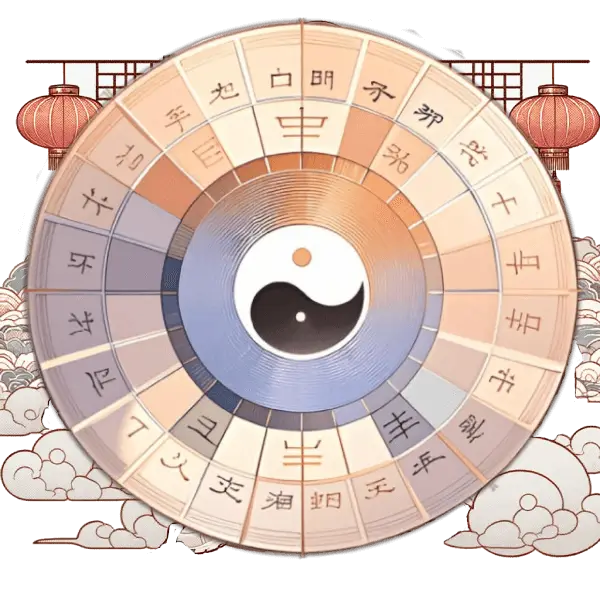
Free BaZi analysis
After you submit, you’ll get
After you submit birth data, you get a Four Pillars chart and key notes. The report roughly includes:
- Four Pillars chart: stems and branches for year, month, day, and hour (if birth time is unknown, the read focuses on three pillars).
- Chart highlights: a short summary of what the pillars emphasize overall.
- Trait notes: illustrated bullets for key personality or life themes.
- Five Elements balance: stronger vs. subtler traits—how you see yourself and how others may read you.
- Behavior patterns: how you tend to show up when things are going well vs. when you’re strained.
What is BaZi?
BaZi records year, month, day, and hour with the Ten Heavenly Stems and Twelve Earthly Branches—four pillars, eight characters in all. Stem-branch day counting appears in Shang oracle bones; the Han shu "Treatise on Literature" also records related material. The Four Pillars system took shape between the Tang and Song: Li Xuzhong is associated with three-pillar methods, the Song period added the fourth pillar, and the Ziping tradition—transmitted through works linked to Yuan Hai Zi Ping—is what most people call Ziping BaZi today. With Five Elements and Ten Gods, it can outline tendencies and timing. See the intro article for historical detail.
How BaZi is calculated
Calculation starts with Yin–Yang and the Five Elements: wood, fire, earth, metal, and water generate and control one another. You also need monthly strength (month branch), and whether the Day Master is in season, rooted, or supported, to see what dominates the chart. Ten Gods describe how other stems and branches relate to the Day Master—Friend, Rob Wealth, Output, Wealth, Officer, Resource, and so on—not to judge good or bad, but to describe habits, resources, and pressure in everyday terms.
Each earthly branch can hide one to three stems (hidden stems). A chart cannot be read from the four pillars alone; clash, combine, and strength shifts matter too. Useful elements, the Day Master's strength, seasonal tuning, and annual cycles all need the full four pillars, hidden stems, and major-year context, read together with Five-Element balance—single labels alone mislead. See the Five Elements and chart-analysis articles for detail.
Related tutorials
Expert-led development
Built by Teacher Ming from classical texts including San Ming Tong Hui and Di Tian Sui, with formulas cross-checked against years of case work; charting and interpretation share the same calculation basis.
What accurate charting requires
Chart accuracy depends on solar terms, true solar time, and birthplace. The system applies standard corrections from your input; see the charting guide for steps. True Solar Time Calculator
How BaZi relates to everyday life
Traits, timing, and Five-Element tone in a chart can inform self-understanding, work, and relationships. The two points below explain how this page's trial differs from generic template tools.
Formulas & copy by the author
Metaphysics and code are written in-house; chart output and text share the same calculation and interpretation rules.
Works without birth time
Choose unknown time for a three-pillar read with elemental tone and traits, for you or someone else.
Topic article index
28 articles
A few starter essays; the full set is in the article list.
BaZi Follow Patterns (Cong Ge) Explained + Free Chart
Regular patterns use Day Master strength to choose support or control. Read it with the full chart and luck cycles.
BaZi Analysis: Day Master Strength & Useful God
After charting, first ask whether the Day Master is strong or weak. If this step is wrong, the Useful God and luck-cycle analysis will also be wrong.
BaZi for Career, Marriage, Kids & Health
Career, wealth, marriage, children, and health are read as tendencies through the Ten Gods, palaces, and luck cycles, then checked against reality.
BaZi Friend Combines or Controls Wealth: Loss vs Lending
The moment students hear loss of money, they ask first: is it Friend/Rob Wealth controlling Wealth? Read it with the full chart and luck cycles.
From classical texts to code: how we build it
Patterns, interactions, solar terms, and imagery from Yuan Hai Zi Ping, San Ming Tong Hui, and Di Tian Sui are not pasted into the page. Teacher Ming's team breaks them into testable rules and edge cases, then implements them as modular code wired into the charting and interpretation flow.
Since launch, the system has been cross-checked against case work, tuning weights and exceptions. The calculation on this page matches the result view. The process and copy are original to this site, not scraped from elsewhere.
Want a deeper look at your annual wealth luck?
Free BaZi analysis covers your chart basics. For full-year main income, windfall timing, investment cues, and a daily wealth calendar, see the annual wealth report.
Paid2026 Annual Wealth Report
BaZi wealth flow + Zi Wei—your full-year money rhythm
- Main income, windfall, investment timing & loss risk
- Twelve-month wealth trends and income structure
- Daily wealth calendar and practical money tips