
Free Zi Wei Dou Shu Chart
Twelve palaces online, with natal and annual highlights
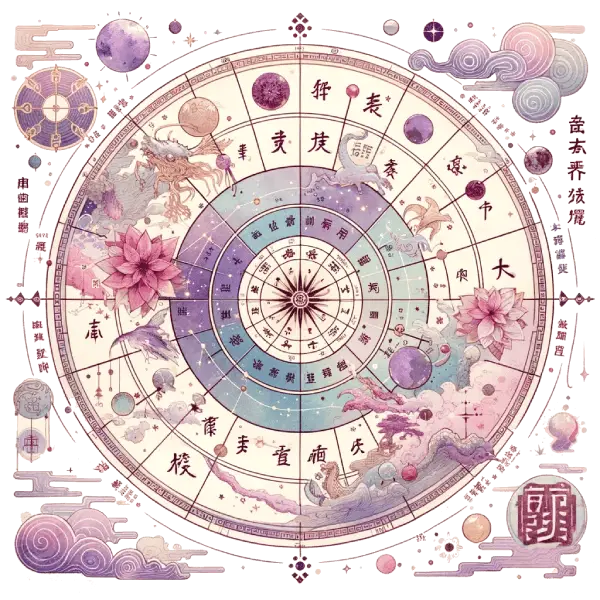
Start here: free Ziwei analysis
After you submit, you’ll get
After you enter birth data, the system charts your case and summarizes personality, major luck, and yearly themes. Below is the free-tier outline.
- Summary of the twelve palaces and star placement
- Natal major-star traits and overall chart tone
- Current ten-year luck and yearly theme notes
- Highlights for career, wealth, and marriage palaces (free tier is concise)
- Use the tutorials below to follow up on stars and transformations
How natal, decade, and annual notes are written
Once the chart is cast, natal, decade, and annual notes follow your major stars, sihua, and palaces, so you can read character, work, and relationships against the plate.
What is Zi Wei Dou Shu?
Zi Wei Dou Shu is one of the traditional Chinese fate-reading systems. It is linked in tradition to Chen Tuan of the late Five Dynasties and early Song; the earliest extant texts are mostly from the Ming. It shares roots with older astral arts such as Qizheng Siyu and took in some outside astrological influence. Twelve palaces, stars, and luck cycles are used to read career, marriage, and life events—much like horoscopic astrology.
How Ziwei works (plain-language)
The chart is anchored on the Life palace; Career, Wealth, Spouse, and other palaces map to life domains. Where major and minor stars fall, and how they aspect or sandwich each other, sets each domain’s tone. The four transformations (Lu, Quan, Ke, Ji) mark how stars shift over time and are usually read with major luck, annual, and monthly cycles. Schools differ—triple harmony, flying stars, self-transformation—but all need the full chart and luck context; single labels are not enough.
Patterns, strength, and useful palaces require star brightness, three- and four-direction links, and stacked luck—a single star name cannot settle good or ill. See the tutorials on major stars, four transformations, and analysis logic for detail.
Related tutorials
Expert-led development
Teacher Ming built this system from classical Ziwei texts and live practice, drawing on Qintian four transformations and southern-line methods, and tuning the formulas from years of use.
Why accurate charting matters
Chart accuracy depends on calendar rules, solar terms, midnight day rollover, and birth location (true solar time). We apply standard corrections from your inputs. To match major stars, minor stars, and transformations step by step, see the charting guide. True Solar Time Calculator
How Ziwei helps everyday life
A chart can summarize temperament, palace themes, and luck rhythms for self-understanding, work, and relationships.
Formulas & copy by the author
Formulas and explanations are written in-house, using professional charting methods—not off-the-shelf templates.
Articles that match your chart
Site tutorials explain palaces, stars, and transformations so you can compare them with your chart.
Topic article index
80 articles
A few starter essays; the full library and sixty patterns are in the article list.
How to Read Zi Wei Dou Shu | Sanhe, Flying Stars, Self-Hua
The chart is cast and the stars are in place—where do you start reading? Looking up stars one by one in a dictionary easily loses the whole.
Zi Wei Dou Shu Virtual Stars | Not Tonight’s Sky
Doushu star names come from the Ziwei Enclosure, the Northern Dipper, and the Southern Dipper, but charting does not look at the sky on the night of birth.
How to Calculate a Zi Wei Dou Shu Chart
The charting sequence is fixed. If star positions are wrong, patterns and sihua that follow will be off.
Zi Wei Dou Shu Ding-Year Sihua: Taiyin Hua Lu & Jumen Hua Ji
People born in a Ding year have a fixed natal sihua: Taiyin Hua Lu, Tiantong Hua Quan, Tianji Hua Ke, Jumen Hua Ji.
From classical texts to code: how we build it
Teacher Ming broke the formulas down from classical texts and coded them line by line, with test cases to verify charting matches the readings.
In production for years, we refine formulas and edge cases from real cases. The logic on this page matches the result view. The text and code are original to this site—not scraped elsewhere.