
Wuqu and Qisha in Mao/You Life Palace
This guide explains Wuqu and Qisha in the Mao/You Life Palace, from its natural strengths and tensions to its effects on work, money, and close bonds.
On this page
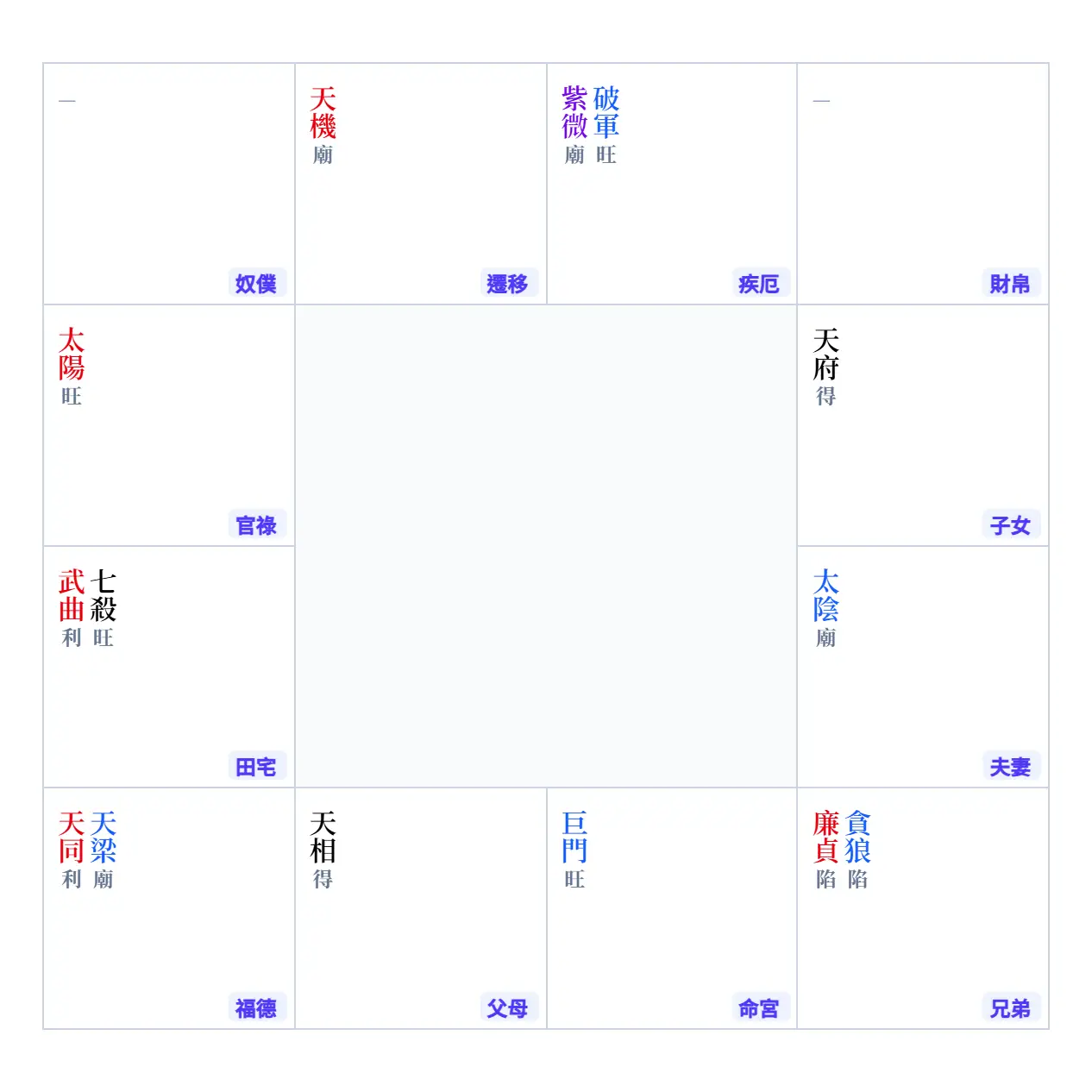
Two general stars together: easy to take up a blade for money
Wuqu and Qisha in Mao/You Life Palace: opposite is Tianfu, the Career Palace is Ziwei and Pojun, and the Wealth Palace is Lianzhen and Tanlang. Wuqu is a general star—solitary, hard, and rigid. Qisha is a senior general: wins and losses both run large, and it also marks loneliness. Two warrior stars sharing a palace make a fierce fighting nature—competitive, unwilling to yield, plenty of nerve but short on foresight, and help is scarce. That is why the pattern carries the danger of 因財持刀 (holding a blade for wealth): for money or career, the native collides head-on with others. Mao palace also has 木壓雷驚 (Mu Ya Lei Jing, wood pressing thunder): Mao wood presses Wuqu metal, so the native is even easier to provoke. The temperament is rigid, daring, and sharp, yet impatient and rash, so conflict comes easily and life swings are large. Lucun or Hua Lu is needed to hold the violence; Zuofu/Youbi, Tiankui/Tianyue, and Wenchang/Wenqu also round the person. Career Palace Ziwei and Pojun in Chou/Wei are in temple (bright/strong): they can pioneer, yet they attack rather than hold. Wealth Palace Lianzhen and Tanlang in Si/Hai sit weak: spending is wide, the pocket is thin, and fame outruns real income. Yi and Xin years, with Lucun in Life and Travel, have a steadier pace and can found a household and a career.
Wuqu and Qisha in Mao/You Life Palace by birth year
Yi-year natives, Wuqu and Qisha in Mao/You Life Palace
Lucun in Mao guards Life and Travel, so the pace is steadier and entrepreneurship and founding a household are possible. Career Palace Ziwei Hua Ke: reputation is better, and noblemen colour is stronger. Blessing is thicker; money and career run more smoothly.
Xin-year natives, Wuqu and Qisha in Mao/You Life Palace
Lucun in You guards Life and Travel, so the violence is held by Lu, the pace is steadier, and entrepreneurship and founding a household are possible. Blessing is thicker; money and career run more smoothly, swings are smaller, and ventures more often yield a return.
Teacher Ming's reading: Wuqu and Qisha in Mao/You Life Palace
Do not treat Wuqu and Qisha as “able to fight, therefore able to win.” I read two general stars sharing a palace as plenty of nerve but short on foresight—easy to collide head-on for money. Career can pioneer; money is easy to leave empty. Life swings are large; too much rigidity snaps. Do not treat daring as capital for charging blindly. Lu must be present to hold the violence.
Yi and Xin years share the same point: Lu tethers the violence, and only then is the pace steady. If your year is not listed, do not worry—first understand this star group's temperament.
Wuqu and Qisha in Mao versus You
Career can pioneer; money is easy to leave empty
Career Palace Ziwei and Pojun in Chou/Wei are in temple: the seat is good and pioneering force is strong. The native likes to carve a path alone, yet also vies with superiors for power, so the road meets resistance and is hard. They can reform, yet most often open the way for others. Wealth Palace Lianzhen and Tanlang in Si/Hai sit weak: spending is wide, real income is thin, and fame outruns the pocket.
Rigid, decisive, and rebellious; only Lu can hold it
The native is rigid, daring, quick to react, and capable. Competitive, impatient, and rash, they easily clash with others—even to the point of using hands. Lu or auspicious stars coming to meet round the person, so they can attack and hold; further malefics make too much rigidity snap.
Two warrior stars sharing a palace: heavy killing qi, easy isolation
Wuqu is solitary, hard, and strong; Qisha has large wins and losses and also marks loneliness. Two warrior stars in Mao/You sharing a palace make fighting nature extreme. Competitive and unwilling to yield, they have strategy but lack foresight, help is scarce, and the danger of taking up a blade for money remains.
Learning points: Wuqu and Qisha in Mao/You Life Palace
- Holding a blade for wealth; Qingyang, Tuoluo, Huoxing, and Lingxing make it snap: this group is already hard, with heavy killing qi. Further Qingyang, Tuoluo, Huoxing, Lingxing, or Hua Ji, and too much rigidity snaps—easy to take up a blade for money, or to be robbed because of wealth. Military, police, butchery, and surgery are trades that can spend the killing qi.
- Hua Lu is needed before pioneering can truly enrich: Wuqu Hua Lu, Lianzhen Hua Lu, or Tanlang Hua Lu all mark pioneering that can create wealth. Without a real opening, only large career swings remain. The native spends widely, yet real income is not large. Pojun Hua Lu marks side jobs and concurrent work: often an unintended willow takes root and becomes the family trade.
- Wenchang and Wenqu only like sharing with Tianfu: Chang and Qu sitting with opposite Tianfu will not spoil pioneering force. Meeting 祿馬交馳 (Lu-Ma interlocking)—Lu and Tianma arriving together—favours making money away from home.
- Wuqu–Qisha need Lu, and also noblemen to help: Hua Lu or Lucun sharing or shining in is what lets pioneering yield a return and the road run smoother. Zuofu/Youbi and Tiankui/Tianyue round the person; leaving room in dealings keeps vision from staying short and treatment of others from staying thin. This is a hero at the end of the road meeting a nobleman.
Teacher Ming's reading: how to read Wuqu and Qisha in Mao/You
To close this article: Wuqu and Qisha carry heavy killing qi and the risk of holding a blade for wealth. The Career Palace can pioneer; the Wealth Palace pocket is thin. Only Lu can hold it; Qingyang, Tuoluo, Huoxing, and Lingxing make it snap. Killing qi needs an outlet.
Three points are enough to remember. First, two hard things together are not double force. Second, killing qi needs an outlet. Third, in a narrow place, what counts is leaving room.
Another Life Palace chart of the same main star: Wuqu in Chen/Xu Life Palace: Pattern Guide.
To check whether your chart is Wuqu and Qisha in Mao/You Life Palace, first use the free Zi Wei Dou Shu chart tool against this article, then read The fourteen main star types and meanings for Wuqu and Qisha’s basic nature, and A complete explanation of Ziwei Doushu sihua for how each birth-year sihua strengthens or weakens the stars.
Master Ming
Zi Wei Dou Shu & BaZi practitioner
Master Ming has studied metaphysics for over 20 years and works mainly in Xiangshu Xinxue Zi Wei Dou Shu, Bazi, and Qi Zheng Si Yu. He trained under Master Liu Jin Fu and Master Huang Ren Long in Taiwan, Master Leung Kim Ho in Hong Kong, and more than ten other teachers across China and Taiwan.
Alongside traditional chart work, he developed and continues to fine-tune the site's own AI engine to help organize readings after the charts are calculated.
About Teacher Ming