
Wuqu and Tanlang in Chou/Wei Life Palace
Decode Wuqu and Tanlang in the Chou/Wei Life Palace with a focused reading of temperament, opportunities, risks, career development, wealth, and relationships.
On this page
Wu-Tan does not prosper the young; Chou is better than Wei
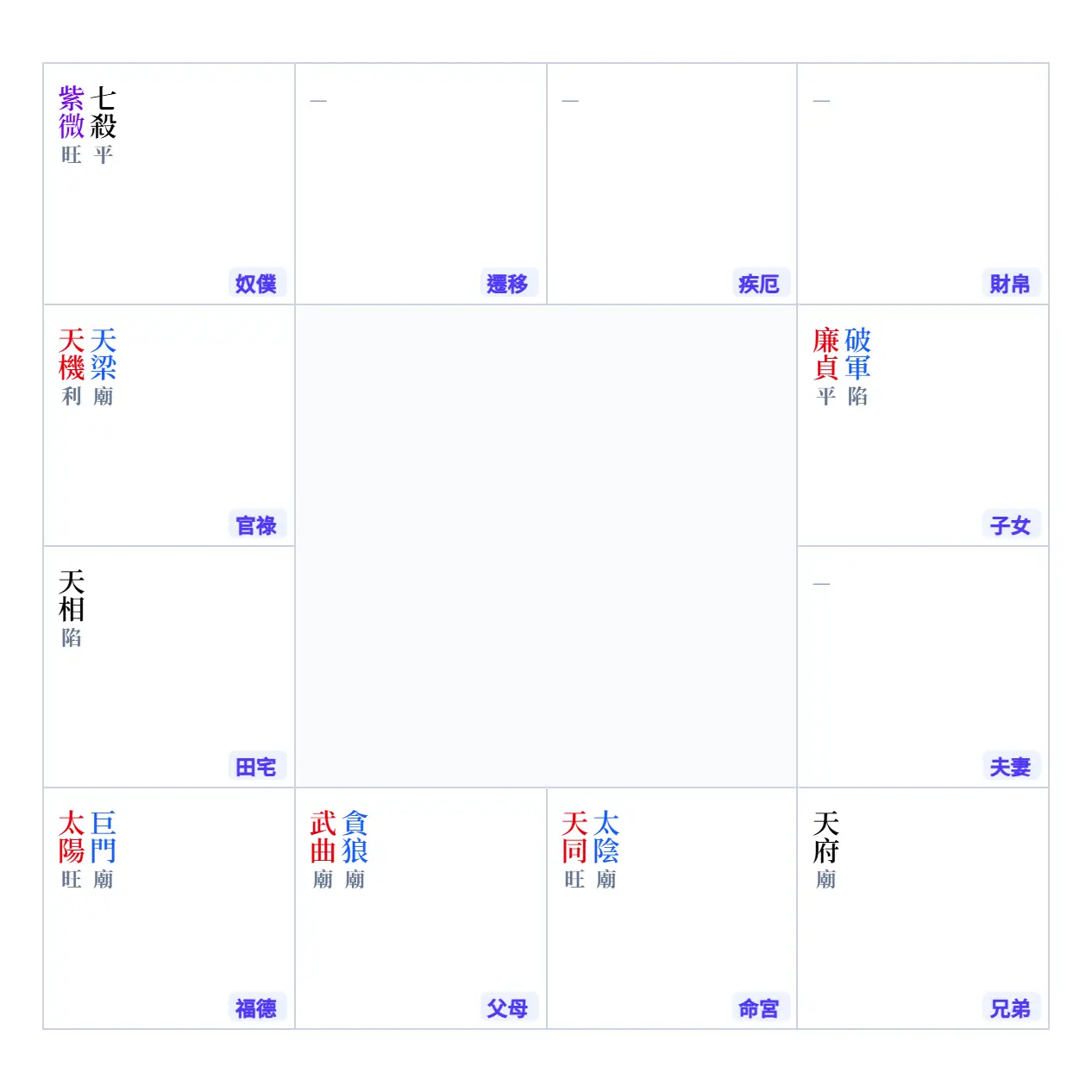
Wuqu and Tanlang in Chou/Wei Life Palace: opposite has no main star, the Wealth Palace is Lianzhen and Pojun, and the Career Palace is Ziwei and Qisha. Wuqu is a wealth star and a general star—nerve and money. Tanlang is a desire star; desire pushes the native forward. Two stars together make a heavy hunger for power, high drive, and little fear of setback—strong material for large business. In youth, seasoning is short: impatient, not yet rounded in method, easy to offend. Classic texts therefore say 武貪不發少年人 (Wu-Tan does not prosper the young): rising too early goes to the head; success is fast and collapse is just as fast. Left and right are clamped by Taiyang and Taiyin. Taiyang governs honour, Taiyin governs wealth, so family resources and study conditions are often better than others’. In Chou palace the sun and moon are both bright, so money and name keep up more readily; in Wei palace their light is weak, so money and status sit a notch lower. Career tends to surge about every seven years; true peak comes after midlife. The old verse says 貪武墓中居,三十才發福 (Tan-Wu dwelling in the tomb, fortune only after thirty). This chart must have Lu. Lu means Lucun or Hua Lu: it tethers excess rigidity and also marks wealth.
Wuqu and Tanlang in Chou/Wei Life Palace by birth year
Wu-year natives, Wuqu and Tanlang in Chou/Wei Life Palace
Life Palace Tanlang Hua Lu: the native is more flexible and social. Lucun in Si guards the Spouse–Career line. Tiankui and Tianyue in Chou/Wei, so Life and Travel both have noblemen—坐貴向貴 (sitting with noblemen, facing noblemen). Further Huoxing or Lingxing thicken unexpected wealth, and the source of money is also proper.
Ji-year natives, Wuqu and Tanlang in Chou/Wei Life Palace
Life Palace Wuqu Hua Lu and Tanlang Hua Quan: name and money keep up more readily. In Chou palace this year, Lucun sits in the Servants Palace—the palace of working for others—so ability is strong, yet most of the labour is for someone else. Lucun is clamped front and back by Qingyang and Tuoluo; Tuoluo entering Career makes the career easy to stall and reverse. Qingyang in Travel means more competition away from home.
Geng-year natives, Wuqu and Tanlang in Chou/Wei Life Palace
Life Palace Wuqu Hua Quan; Parents Palace Taiyang Hua Lu and Siblings Palace Taiyin Hua Ke: left and right are clamped by noble stars, so family shelter is thicker and life stays close to noblemen. Tiankui and Tianyue in Chou/Wei again form 坐貴向貴. Ambition runs large; not every wish is filled.
Xin-year natives, Wuqu and Tanlang in Chou/Wei Life Palace
Lucun in You guards the Wealth–Fortune line. Parents Palace Jumen Hua Lu and Taiyang Hua Quan clamp Life. Tiankui in Wu and Tianyue in Yin: noblemen help is plentiful. Further Huoxing or Lingxing make unexpected wealth arrive more suddenly.
Teacher Ming's reading: Wuqu and Tanlang in Chou/Wei Life Palace
Do not treat Wu-Tan as a youth that can already prosper. I read this group as heavy hunger for power and high drive, yet youth lacks seasoning: rising too early goes to the head, and success is fast and collapse is just as fast. Clamped left and right by sun and moon, family resources are often better. Career tends to surge about every seven years; true peak comes after midlife. This chart must have Lu.
Wu, Ji, Geng, and Xin years share the same point: only Lu tethers excess rigidity. If your year is not listed, do not worry—first understand this star group's temperament.
Wuqu and Tanlang in Chou versus Wei
Proper Wu-Tan clamped by sun and moon; Chou is better than Wei
This is the proper 武貪 (Wu Tan) pattern. Taiyang governs honour, Taiyin governs wealth; clamping Life, family resources and study conditions are often better, so the native is more easily cultivated. In Chou palace the sun and moon are both bright; in Wei palace their light is weak, so money and name sit a notch lower. Both can rely on family help; the difference is background.
General stars in the right seat: suited to commerce and to martial posts
Both are wealth stars. Wuqu has nerve, Tanlang can network, and the means of seeking wealth are more flexible—called 良益互援 (liang yi hu yuan, mutual aid of two benefits). General stars sitting in the right place suit business or military and police; leaving home to develop is best. Peak is in midlife. Qingyang, Tuoluo, Dikong, Dijie, or Hua Ji break the pattern: even if there is a rise, success is fast and collapse is just as fast.
Wu-Tan does not prosper the young; early rise easily becomes a bubble
Wuqu is a wealth star and a general star; Tanlang is a desire star. Sharing a palace, hunger for power is heavy, drive is high, and challenge is welcome. Youth lacks seasoning: impatient, not yet rounded in method. Rising too early goes to the head; success is fast and collapse is just as fast.
Learning points: Wuqu and Tanlang in Chou/Wei Life Palace
- Tanlang Hua Lu meeting Huoxing or Lingxing: unexpected wealth arrives suddenly: Tanlang Hua Lu stacked with Huoxing or Lingxing is called 火貪 (Huo Tan) or 鈴貪 (Ling Tan). Unexpected wealth is thicker; even without sharing a palace it arrives suddenly, and the source is also proper. Lianzhen Hua Lu makes earning smoother.
- Wu-Tan must have Lu; Quan without Lu will not do: both are wealth stars. Wuqu Hua Quan is ambition too large: unexpected wealth may come, yet the heart is never filled; further malefics make this clearer. With Lu, this chart can stand.
- Malefics mean living by a craft; Tiankui/Tianyue can hold financial power: with malefics, a specialised skill can earn a living. Without malefics and with Tiankui/Tianyue, real economic power is more likely. Meeting 祿馬交馳 (Lu-Ma interlocking)—Lu and Tianma arriving together—large business away from home is more likely to succeed.
- Watch Pojun Hua Lu and Ziwei Hua Quan: Pojun Hua Lu makes Life Palace Tanlang Hua Ji, so ambition grows larger; do not further stack Qingyang, Tuoluo, or empty-robbery stars, or the means of seeking wealth easily turn crooked. Ziwei Hua Quan makes Wuqu Hua Ji: without assistants and with empty stars, the native loves to wield power yet lacks the skill.
- Do not let Wenchang and Wenqu sit with Wu-Tan: material desire should be contested openly and squarely; excessive polish is disliked. Wenchang/Wenqu sharing the palace is like powder and paint: seeking wealth easily carries trickery and concealment.
- Tanlang entering a storehouse, without malefics, tends toward longer life: Tanlang is a longevity star; Chou/Wei are storehouse palaces. Without malefics breaking through, the native lives longer. Wealth Palace is Lianzhen and Pojun; Pojun swings large, so Hua Lu, Hua Quan, or Lucun is needed before days are steady. Dikong, Dijie, or Hua Ji make money easy to break and life laborious.
Teacher Ming's reading: how to read Wuqu and Tanlang in Chou/Wei
To close this article: Wuqu and Tanlang is a proper pattern that does not prosper the young; peak is in midlife. Lu must be present; Quan without Lu will not do. Malefics break the pattern. Wenchang and Wenqu should not share the seat; material desire should be contested openly and squarely.
Three points are enough to remember. First, it does not prosper the young; peak is in midlife. Second, Quan without Lu leaves the heart unfilled. Third, material desire should be contested openly and squarely.
Another Life Palace chart of the same main star: Wuqu and Tianxiang in Yin/Shen Life Palace.
To check whether your chart is Wuqu and Tanlang in Chou/Wei Life Palace, first use the free Zi Wei Dou Shu chart tool against this article, then read The fourteen main star types and meanings for Wuqu and Tanlang’s basic nature, and A complete explanation of Ziwei Doushu sihua for how each birth-year sihua strengthens or weakens the stars.
Master Ming
Zi Wei Dou Shu & BaZi practitioner
Master Ming has studied metaphysics for over 20 years and works mainly in Xiangshu Xinxue Zi Wei Dou Shu, Bazi, and Qi Zheng Si Yu. He trained under Master Liu Jin Fu and Master Huang Ren Long in Taiwan, Master Leung Kim Ho in Hong Kong, and more than ten other teachers across China and Taiwan.
Alongside traditional chart work, he developed and continues to fine-tune the site's own AI engine to help organize readings after the charts are calculated.
About Teacher Ming