
Ziwei and Tanlang in Mao/You Life Palace
This guide explains Ziwei and Tanlang in the Mao/You Life Palace, from its natural strengths and tensions to its effects on work, money, and close bonds.
On this page
Peach blossom offends the lord; extreme residence in Mao/You often turns to quiet cultivation
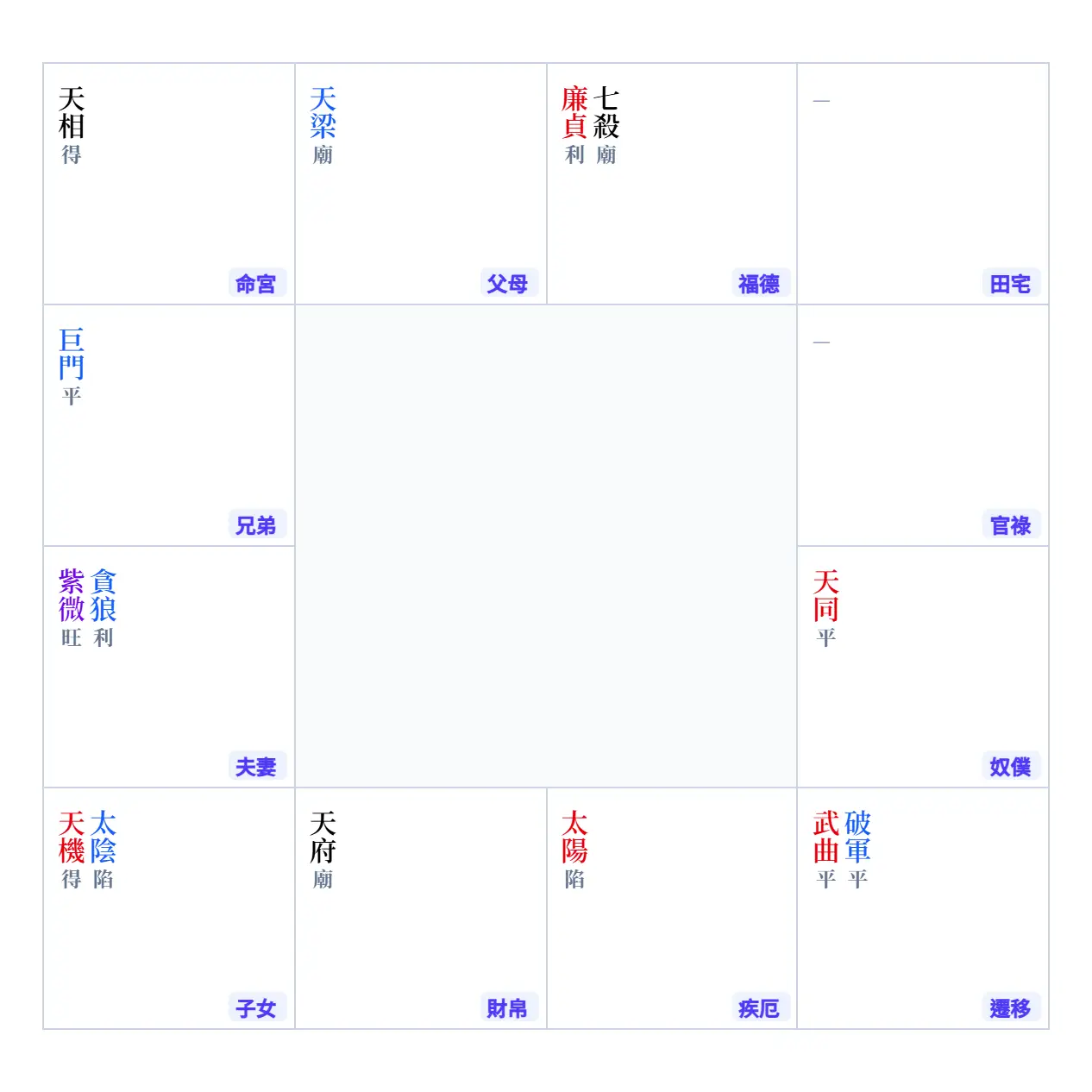
Ziwei and Tanlang in Mao/You Life Palace: the ancients called it 桃花犯主 (tao hua fan zhu, peach blossom offends the lord)—romance easily strikes the native. Emperor star and desire star sit together; opposite has no main star, the Wealth Palace is Wuqu and Pojun, and the Career Palace is Lianzhen and Qisha; all three directions lean toward material desire. Romance is easily liked. Most feared is further peach-blossom stars, or Tanlang Hua Lu or Hua Quan, so Ziwei cannot hold Tanlang: money is earned, yet the native falls in feeling. Tanlang Hua Ji reduces peach blossom a little; material desire remains, only it cannot be reached, so unused talent is a common feeling. Zuofu/Youbi and Tiankui/Tianyue are needed to gather it, before leadership has weight; with no one to gather it, petty people come near. Do not treat Ziwei–Tanlang sharing a palace as a good life. Desire at its peak reverses; meeting Dikong, Dijie, or Huagai, the native often turns toward religion. Classic texts say 極居卯酉 (Ji Ju Mao You, extreme residence in Mao/You): many take the path of quiet cultivation.
Ziwei and Tanlang in Mao/You Life Palace by birth year
Jia-year natives, Ziwei and Tanlang in Mao/You Life Palace
Career Palace Lianzhen Hua Lu: ability is stronger, the post runs more smoothly; Tiankui sharing the palace makes meeting people in power easier. Wealth Palace Pojun Hua Quan and Wuqu Hua Ke: Ke, Quan, and Lu all shine onto Life—called 三奇佳會 (San Qi Jia Hui, three wonders meeting). You palace is better than Mao palace, because in a Jia year Qingyang happens to enter Mao.
Yi-year natives, Ziwei and Tanlang in Mao/You Life Palace
Life Palace Ziwei Hua Ke: leadership rises, Tanlang is held a little, more favourable to scholarship and teaching. Lucun in Mao guards Life and Travel; this year’s chart has more force.
Ji-year natives, Ziwei and Tanlang in Mao/You Life Palace
Wealth Palace Wuqu Hua Lu: a wealth star entering a wealth seat, money comes more steadily; Life Palace Tanlang Hua Quan: desire is heavier. Tianliang Hua Ke in Property, Lucun in Wu shining onto the Children–Property line: money and name keep up more readily.
Xin-year natives, Ziwei and Tanlang in Mao/You Life Palace
Parents Palace Jumen Hua Lu, Lucun in You guarding Life and Travel: seeking wealth runs more smoothly. Tiankui in Wu shining onto the Children–Property line: money and name keep up more readily.
Teacher Ming's reading: Ziwei and Tanlang in Mao/You Life Palace
Do not treat Ziwei–Tanlang sharing a palace as splendour. I read Ziwei and Tanlang in Mao/You as what the ancients called peach blossom offends the lord: a desire star sitting on the emperor’s seat, so romance easily strikes the native. Money can be earned; feeling is easy to fall in. Desire at its peak reverses; meeting Dikong, Dijie, or Huagai, the native often turns to quiet cultivation. Put plainly: desire needs someone to gather it.
Jia, Yi, Ji, and Xin years share the same point: Lu and Ke-Quan hold the chart. If your year is not listed, do not worry—first understand this star group's temperament.
Ziwei and Tanlang in Mao versus You
Extreme residence in Mao/You meeting robbery and emptiness: most take quiet cultivation
Three directions meeting empty-vanishing, Dikong, Dijie, Huagai, or Hua Ji: the native is more lofty, and days are also bumpy. Empty-vanishing entering Life deepens the tie to religion. Wealth Palace is Wuqu and Pojun: a wealth star paired with a spending star, money in on one side and out on the other—comes fast and goes fast.
Ziwei–Tanlang desire runs deep; at the peak it turns to religion
Emperor’s seat and desire sharing a palace: people and things are wanted to the extreme. Three directions Wuqu–Pojun and Lianzhen–Qisha also lean toward material desire. Desire at its peak reverses; after splendour, emptiness often follows. Meeting Dikong, Dijie, or malefics, faith is most easily entered.
Ziwei and Tanlang in Mao/You: the ancients called it peach blossom offends the lord
The ancients called it 桃花犯主. Tanlang Hua Lu or Hua Quan, and Ziwei cannot hold: material desire and romance run deep; money is earned, yet the native falls in feeling. Without Zuofu/Youbi and Tiankui/Tianyue to gather it, petty people come near; many malefics make plans hard to finish. Classic texts say that without restraint it is 無益之人 (wu yi zhi ren, a person of no benefit).
Learning points: Ziwei and Tanlang in Mao/You Life Palace
- Without peach blossom, this group is in fact very usable: frank, active, resilient, quick to react, and able to read the room. Tanlang is born with a strong hunger to know, versatile, and often has a speciality in the arts.
- Ziwei–Tanlang, compared with Ziwei sitting alone, adds strategy and manoeuvre: action is more active, competition is not feared. With malefics, any means are often used for the goal. Whether it turns toward good or goes crooked depends entirely on auspicious transformations and people to gather it; a little malefic is fine—the point is restraint.
- Peach blossom offends the lord; most feared is further Wenchang, Wenqu, and Tianyao: further Wenchang/Wenqu, Tianyao, Xianchi, Luanxi, Muyu, or Dahao: ties run thick, and feeling easily delays career. Even without those stars, romance is liked and play is taken as it comes. Life Palace and Spouse Palace must be read together. Tianxing, Dikong, Dijie, or Huagai can give self-discipline: peach blossom lessens a little, yet material desire remains deep.
- Peach blossom offends the lord plus Huoxing, Lingxing, or Qingyang: methods easily turn heavy: talent is present, yet desire runs too deep; for the goal, speculation and any means come easily. Classic texts write 鼠竊偷盜之輩 (shu qie tou dao zhi bei, thieves and petty criminals)—harsh wording; desire must have someone to gather it.
- Ties with the other sex often help career: talented or wealthy people of the other sex are often met; achievement is sometimes related to this layer, even becoming marriage. Not everyone is like this; it depends on temperament and restraint.
Teacher Ming's reading: how to read Ziwei and Tanlang in Mao/You
To close this article: Ziwei and Tanlang in Mao/You have deep material desire and peach blossom close at hand. Without peach blossom, this group is in fact very usable—quick manoeuvre, many arts. Meeting Dikong, Dijie, or Huagai, after splendour the native often turns to quiet cultivation. Zuofu/Youbi and Tiankui/Tianyue give leadership its weight; with no one to gather it, petty people come near. Money comes fast and also goes fast.
Three points are enough to remember. First, desire needs someone to gather it, or it turns back. Second, without peach blossom, this group is very usable. Third, after splendour, being willing to turn empty is what lasts.
Another Life Palace chart of the same main star: Ziwei and Tianxiang in Chen/Xu Life Palace.
To check whether your chart is Ziwei and Tanlang in Mao/You Life Palace, first use the free Zi Wei Dou Shu chart tool against this article, then read The fourteen main star types and meanings for Ziwei and Tanlang’s basic nature, and A complete explanation of Ziwei Doushu sihua for how each birth-year sihua strengthens or weakens the stars.
Master Ming
Zi Wei Dou Shu & BaZi practitioner
Master Ming has studied metaphysics for over 20 years and works mainly in Xiangshu Xinxue Zi Wei Dou Shu, Bazi, and Qi Zheng Si Yu. He trained under Master Liu Jin Fu and Master Huang Ren Long in Taiwan, Master Leung Kim Ho in Hong Kong, and more than ten other teachers across China and Taiwan.
Alongside traditional chart work, he developed and continues to fine-tune the site's own AI engine to help organize readings after the charts are calculated.
About Teacher Ming