
Tiantong and Jumen in Chou/Wei Life Palace
Read Tiantong and Jumen in the Chou/Wei Life Palace, including its core temperament, strengths, risks, and influence on career, wealth, and relationships.
On this page
Mood stuck in old wounds; Chou is brighter than Wei
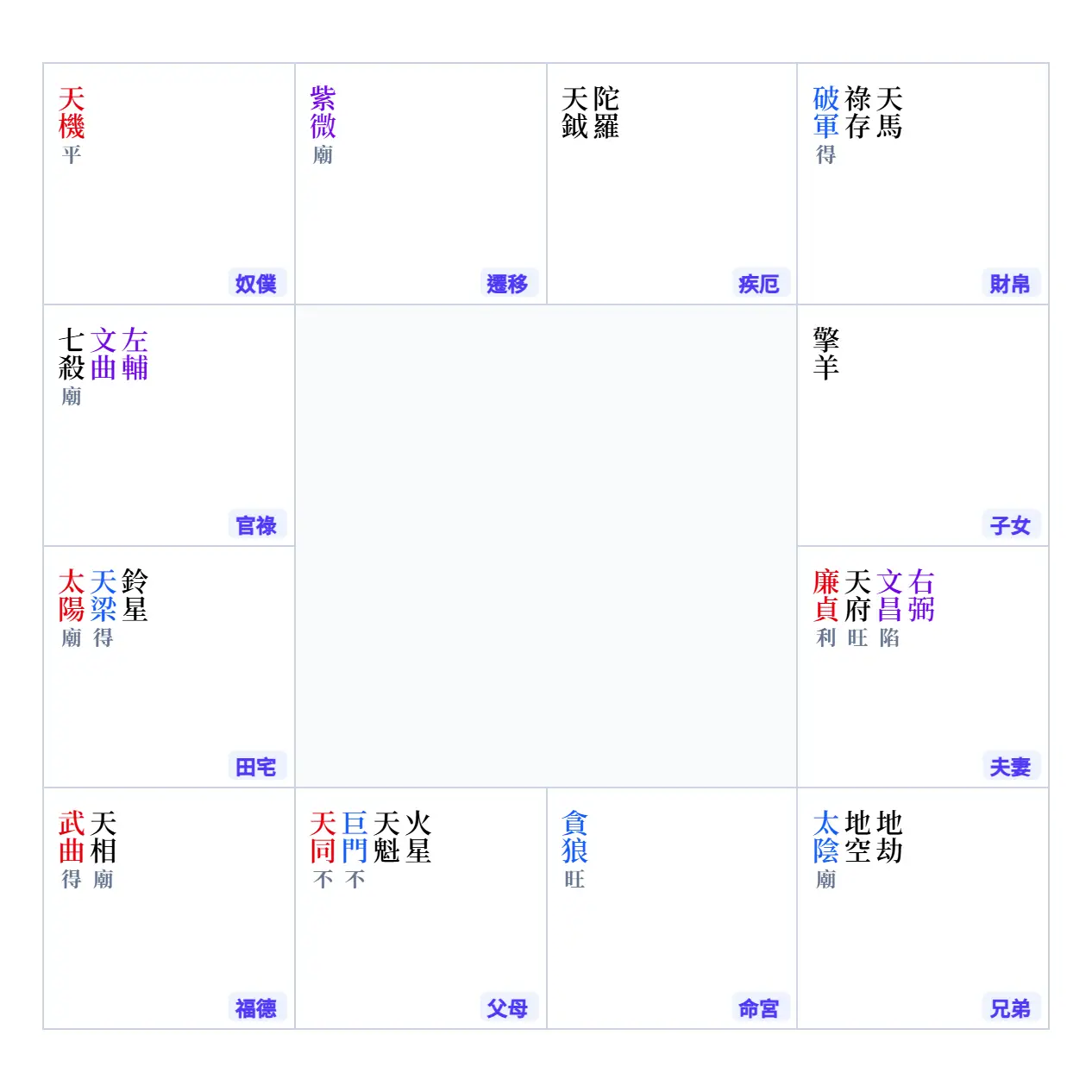
Tiantong and Jumen in Chou/Wei Life Palace: opposite has no main star, the Wealth Palace in Mao/You is also empty, and the Career Palace is Tianji in Si/Hai. Tiantong governs mood and is childlike; feelings are easily pulled by nearby stars. Jumen is a dark star of speech and dispute. Together, mood swings are strongest; unguarded speech brings trouble from the mouth, and the heart stays stuck in old wounds, becoming unspoken hidden pain—隱痛格 (Hidden-Pain Pattern). Both stars sit dark in Chou/Wei, called weak/fall: strengths do not open, and darkness plus emotion weigh more. Outwardly easygoing, inwardly stubborn and suspicious, they tend to assume the worst. The Spouse Palace is Taiyin: the native is sentimental and imaginative, while the partner is quiet and reserved, so security feels thin—more tiring for female charts on this line. Money is hard to keep, work likes to change, and public service or a large organisation with a steady salary fits better. Quality first depends on Fortune Palace Taiyang: in Chou, Taiyang in Mao is brighter, so the person is more open; in Wei, Taiyang in You is like sunset, and the darkness is harder to dissolve.
Tiantong and Jumen in Chou/Wei Life Palace by birth year
Bing-year natives, Tiantong and Jumen in Chou/Wei Life Palace
Life Palace Tiantong Hua Lu: Lu is blessing, so the native is more optimistic and more willing to enjoy. Career Palace Tianji Hua Quan: Quan is decisiveness, so work is easier to hold. Lucun in Si and Tiankui in Hai guard the Spouse and Career line; Tianyue in You guards Wealth and Fortune. Career can be built, and money comes in more readily.
Xin-year natives, Tiantong and Jumen in Chou/Wei Life Palace
Life Palace Jumen Hua Lu: speech opens the road, and the dark side thins. Fortune Palace Taiyang Hua Quan: temperament is brighter and the situation opens. Lucun in You guards Wealth and Fortune. With Hua Lu in the natal chart and Lucun in You, Lu appears in two places, so money comes more thickly and great wealth is possible.
Gui-year natives, Tiantong and Jumen in Chou/Wei Life Palace
Life Palace Jumen Hua Quan: Quan is decisiveness and persuasion, so the dark side lessens. Speech carries more weight, suited to diplomacy, education, and media work that lives on eloquence. Expression has authority, so the native can stand alone.
Ding-year natives, Tiantong and Jumen in Chou/Wei Life Palace
Life Palace Tiantong Hua Quan and Jumen Hua Ji. Quan is drive; Ji is the snag. Qingyang in Wei guards Life and Travel; classic texts say 巨破擎羊性必剛 (Jumen, Pojun, and Qingyang make the nature harsh). Quan and Ji arriving together make the native self-regarding and argumentative, so disputes increase.
Career Palace Tianji Hua Ke: Ke is reputation. Spouse Palace Taiyin Hua Lu shines across, called 暗祿生財 (hidden Lu generating wealth). The structure is good; with Zuofu/Youbi and Wenchang/Wenqu as well, enterprise, education, or media can all be handled independently. Tiantong and Jumen already have a two-sided nature; a Ding year makes it more obvious.
Teacher Ming's reading: Tiantong and Jumen in Chou/Wei Life Palace
Do not treat Tiantong and Jumen as merely talkative. I read two stars sharing a palace as the hardest mood to steady: speech out of control brings trouble, and the heart stays stuck in old wounds as unspoken hidden pain. Outwardly easygoing, inwardly stubborn and suspicious, they tend to assume the worst. Money is hard to keep, work likes to change, and public service with a steady salary fits better.
Bing, Xin, Gui, and Ding years share much the same point—Lu thins the dark and adds decisiveness. If your year is not listed, do not worry—first understand this star group's temperament.
Tiantong and Jumen in Chou versus Wei
Chou Taiyang is brighter; Wei is like sunset
The Fortune Palace is where intention starts; Taiyang and Tianliang sit here. When Fortune is poor, judgement leans grey, and money, marriage, and rapport are all dragged down. In Chou, Taiyang in Mao sits bright and can dissolve Jumen’s darkness, so the person is more open and less afraid of malefics. In Wei, Taiyang in You is like sunset and cannot dissolve the dark. Next, read sihua.
Outwardly easygoing; hidden worries in love and money
Both stars sit dark, so strengths do not open. Outwardly easygoing, inwardly stubborn and suspicious, they assume the worst, with vanity, a rebellious streak, and speech that is not always true. The partner’s Taiyin is reserved; the native is sentimental and imaginative, so security feels thin—more tiring for female charts on this line.
Two stars together: mood is hardest to steady
Tiantong governs mood; Jumen governs darkness and speech. Together, mood swings are strongest. Unguarded speech brings trouble; old wounds keep gnawing, and that inner pain is slow to heal. The chest has to be opened on purpose before the negative cycle can be left.
Work likes to change; money is hard to keep
Travel and Wealth both have no main star; Career Tianji in Si/Hai also sits dark, so the way out is not smooth. Sanfang without Lucun easily becomes talent unmet. Opposite Taiyang and Tianliang are stars of clean honour that take money lightly, so the pocket is often tight. Add Huoxing, Lingxing, Dikong, or Dijie, and job changes are even more common. Public service with a steady salary fits; business should rest on a specialised skill.
Learning points: Tiantong and Jumen in Chou/Wei Life Palace
- Sanfang in weak/fall most needs Lucun to shine across: both stars already sit dark, and sanfang only meets Tianji sitting dark, so life is more laborious. Lucun in sanfang steadies it; otherwise talent unmet is common.
- Peach blossom plus Wenchang/Wenqu can go into performing arts and culture: peach-blossom stars in Life, meeting Wenchang and Wenqu, suit performing arts or culture—turning mood and speech into a profession, which is easier than forcing the emotions.
- Spouse Taiyin: male charts fare better than female: a male Spouse Palace Taiyin sharing with Wenqu can gain through marriage. A female Taiyin in Spouse means a softer partner and more emotional strain—read the whole chart before judging.
- Jumen transforming auspiciously is more direct than Tiantong transforming auspiciously: Jumen Hua Lu or Hua Quan thins the dark more readily. Tiantong transforming auspiciously usually needs setbacks first before building from nothing. Both can reduce darkness; Jumen’s line is faster.
- Qingyang, Tuoluo, Huoxing, and Lingxing together is 巨火羊 (Ju-Huo-Yang): both stars already in fall, then stacked with Qingyang, Tuoluo, Huoxing, and Lingxing, raise disputes and accidental injury. Add Tianxing and lawsuits are easier; life is toil and hardship.
- Parents and Fortune need auspicious stars for ancestral leftover blessing: this group often starts from a decent background. If Parents and Fortune have no malefics and have auspicious stars, ancestral blessing can be continued; without auspicious stars, youth looks fine and later years must be self-made.
Teacher Ming's reading: how to read Tiantong and Jumen in Chou/Wei
To close this article: Tiantong and Jumen is 隱痛格 (Hidden-Pain Pattern)—easygoing on the surface, suspicious underneath. Work likes to change, money is hard to keep, and public service fits. Sanfang in weak/fall most needs Lu; Jumen transforming auspiciously thins the dark faster.
Three points are enough to remember. First, only Lu thins the dark. Second, speech must be guarded. Third, once the chest opens, the negative cycle can be left.
Another Life Palace chart of the same main star: Tiantong and Tianliang in Yin/Shen Life Palace.
To check whether your chart is Tiantong and Jumen in Chou/Wei Life Palace, first use the free Zi Wei Dou Shu chart tool against this article, then read The fourteen main star types and meanings for Tiantong and Jumen’s basic nature, and A complete explanation of Ziwei Doushu sihua for how each birth-year sihua strengthens or weakens the stars.
Master Ming
Zi Wei Dou Shu & BaZi practitioner
Master Ming has studied metaphysics for over 20 years and works mainly in Xiangshu Xinxue Zi Wei Dou Shu, Bazi, and Qi Zheng Si Yu. He trained under Master Liu Jin Fu and Master Huang Ren Long in Taiwan, Master Leung Kim Ho in Hong Kong, and more than ten other teachers across China and Taiwan.
Alongside traditional chart work, he developed and continues to fine-tune the site's own AI engine to help organize readings after the charts are calculated.
About Teacher Ming